Recently in Driving With Under the Influence Category

October 19, 2026

Involved in a Hit and Run Accident: Here is What You Need to Do

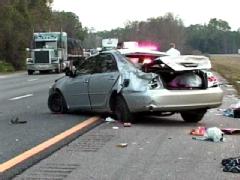
A hit and run accident is when you are involved in an automobile accident and one of the parties involved leaves the scene. This can leave you shaken and upset.
hit and run accident.jpg
Hit and run accidents have been on the rise for the last 10 years. The National Highway Traffic Safety Administration (NHTSA), reports that over 10% of all automobile accidents are hit and run accidents. There are numerous reasons why a person would leave the scene of an accident, but the two most common reasons are: being uninsured and being under the influence of alcohol of drugs.

Here are a few tips in case you are a victim of a hit and run accident:
- Assess your physical well-being as well as any other person involved;
- Call the police and report the accident;
- Write down any information you remember about the vehicle that left the scene;
- Identify any witnesses and obtain contact information from them, so you can contact them at a later time; and
- Call the Ambulance, if necessarily

If you are injured as a result of the hit and run accident it is important to seek emergency medical care. You will also need to contact you insurance company and report the accident. You will need to handle your property damage directly with your insurance company. You will also need to make sure that you have under-insured or un-insured coverage under your own person automotive insurance policy. You may find all this a bit much to handle, and if you do you will need to hire an experienced personal injury attorney to assist you in dealing with the insurance company on your behalf.

September 14, 2026

As Vehicle Deaths in MD Fall, Alcohol Related Deaths Increase by 12%

The number of alcohol related deaths in Maryland has increased by 12%, even as the national count declined. Non-alcohol related deaths in Maryland in 2009, declined by 7%. That means that 44 fewer people died in automobile accidents in Maryland in 2009, than in 2008.

The decline in automobile deaths may be associated with fewer drivers on the road, due to the recession and unemployment. People may also be taking less road trips and therefore there is less congestion on the roads and less chance for multiple car crashes, according to the National Highway Transportation Safety Administration (NHTSA).

In 2009, 162 people died in alcohol related accidents in Maryland, while in 2008, only 145 died. Nationally, however, more than 30,000 lives are being lost a year on our highways, and a third of those involved drunk driving.

Spokesperson for Maryland Governor Martin O'Malley, Shaun Adamec said, "O'Malley would continue to seek stiff penalties for drunken drivers and repeat offenders, and would support the ignition interlock bill if it is reintroduced. The Governor is also committed to investments in the first responder network, including $50 million for new medevac helicopters."

Despite safer automobiles, safer highways, better trauma facilities and more seat belts being used in the United States, Marylanders still drink and drive. Police Officers arrest over 25,000 people a year for drunk driving, in Maryland. Of these, more than 300 are during Labor Day weekend.

Spokeswoman for AAA in Maryland, Christine Delise said, "the organization will continue to advocate for more use of ignition interlock devices for repeat DUI offenders, as well as first time offenders with excessive blood alcohol content."

Lets hope that all these changes and stricter law enforcement will lower the number of both automobile accident deaths and alcohol related accident deaths, not only in Maryland, but nationwide.


September 7, 2026

Costs of Traffic Accidents Have Increased in the United States

The Centers for Disease Control and Prevention (CDC) conducted a study that shows; that the costs associated with injuries from automobile crashes is more that $99 billion a year, nationwide. These costs include medical care costs and loss of productivity costs. Of this, $58 billion was due to fatalities, $28 billion for nonfatal injuries that required hospitalization, and $14 billion was for people treated as outpatients at hospitals. The study was released in August 2010. According to the National Highway Traffic Safety Administration (NHTSA), this number increases considerably when you factor in higher insurance premiums, taxes and delays in travel, to nearly $230.6 billion. Grant Baldwin, Director of the CDC's Division of Unintentional Injury Prevention said, "This study highlights the magnitude of the problem of crash-related injuries from a cost perspective."

Injuries to occupants of motor vehicles, is about $70 billion, motorcyclist $12 billion, pedestrians $10 billion and Cyclists $5 billion.

Injuries and deaths from traffic accidents, however, have been falling. The lowest level since 1961 occurred in 2008, but traffic accidents are still the 9th leading cause of deaths worldwide. It is expected that by the year 2030 deaths caused by traffic accidents will become the 5th, surpassing diabetes, HIV/AIDS and Heart Disease. In the United States, 15 to 16 fatalities as a result of traffic accidents occur per every 100,000 people.

Motor vehicle-related injuries and deaths are preventable in the United States, if more laws were implemented that require helmets for motorcyclists, stricter seat belt, drug, alcohol and texting laws, as well as increasing teen rules until the age of 18.

August 30, 2026

Drunk Driving On the Rise in MD, DC and VA

The National Highway Traffic Safety Administration (NHTSA) is spending over 13 Million on ads and teaming up with about 11,000 police agencies for Labor Day Weekend. It is reported by the government that there are about 17 million drunk drivers a year in the United States, much of which have deadly results.

David Strickland, Administrator for the NHTSA said, "We have got to go more to close the gap between believing that drunk driving is a threat and actively doing something about it."

The message in Virginia is clear: "Drunk Driving, Over the Limit, Under Arrest."
A government survey conducted in 2010 shows that 1 in 5 people admit driving just two hours after drinking, while a quarter of drunk drivers report drinking at least 3 times a week. The survey also shows that 1 in 10 people knowingly get into a vehicle with a drunk driver.

The Director of the Maryland Highway Safety Office, Mr. Vernon Betkey, said, "If we eliminated drunk driving on our highways, and also had 100 percent seatbelt usage, we would cut the amount of fatalities we have by one half."

Bookmark and Share
July 19, 2026

Teen Drivers Risks Higher in the Summer in Washington, D.C., Maryland and Virginia

According to the National Highway Traffic Safety Administration (NHTSA), automobile crashes are the leading cause of death for teenagers in the USA. The deadliest time is the period between Memorial Day and Labor Day for drivers between the ages of 15-20. It is during this time that teens are out of school, have more free time under less parental supervision and have more opportunities to drive at night, when the road risks are higher and their curfews later in the night. Inexperience and Immaturity are the two main factors in teen auto crashes.

Justin McNaull, state relations director for auto club AAA states that, "For many kids, every day in the summer is a weekend day." During the summer teens are less supervised by their parents and allowed more freedom, when it comes to driving. Teenagers also do more purposeless driving, which are more dangerous. Driving at 10pm is different than driving at 7am. The deadliest hours for teens are the hours between 10pm to midnight on Fridays and Saturdays. It is because of their inexperience and immaturity that they tend to maneuver turns carelessly and rear-end other vehicles more frequently, and when you add the fact that they are doing this more at night it becomes even more dangerous.

States and Highway safety officials try to reach out to young drivers, as well as their parents, before the end of the school year to remind them to exercise caution while driving during summer vacation. The Washington Regional Alcohol Program, a non-profit group battling drunken driving and underage drinking in Washington, D.C., Maryland and Virginia, warns parents of the hazards of summer driving through media and parent-teacher organizations. According to this organization, during the summer months there are about 50% more drink driving deaths involving teens than any other time of the year.

Washington, D.C., Maryland and Virginia have implemented laws specifically for teens. Two of the laws implemented are the "Click it or Ticket" and "Seat Belt Laws", which push seat belt usage for teens. Other than what the states can do, parents also need to be more responsible during the summer months for their children.

Bookmark and Share
March 2, 2026

Maryland, D.C. and Virginia Are Considering Ignition Breathalyzers as a Punishment for First Time Offenders

States are increasingly mandating the use of ignition breathalyzers for first-time offenders in order to deter more citizens from drunk driving. Twelve states in the United States already use this as a punishment for drunk driving and Ten States, which include Maryland and Virginia are debating on whether to take the same step.

Congress is also considering whether to push states to mandate the breathalyzers for first-time offenders by withholding federal highway funds.

The Ignition interlock devices will not let the engine start until the driver successfully breathes into a device. These devices are not new, but the technology has become more sophisticated and reliable.

Advocates of these devices believe that they are the most effective tool to come along in the last 30 years. Senator Jamie B. Raskin (D-Montgomery) believes that the punishment implemented now just does not work and that is why we must implement the ignition breathalyzers.

Federal data that was compiled two years ago showed that in Maryland, 25,120 drivers had three or more drunk driving convictions, 4,000 of which had five or more and nearly 70 had more that ten. In the District of Columbia, 34 drivers had more that three convictions.

Lon Anderson of the AAA Mid-Atlantic believes that First-time offenders probably are chronic offenders and have probably escaped detection many times. The National Highway Traffic Safety Administration said last year that studies suggest interlocks "may be necessary as a long term or permanent condition of driving for repeat offenders."

Bookmark and Share
